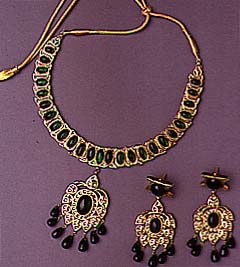
India has a long jewellery history, which went through various changes through cultural influence and politics for more than 5,000-8,000 years. India has the longest continuous legacy of jewellery making anywhere since Ramayana and Mahabharata times. Because India had abundant amount of jewellery resources, it prospered financially through export and exchange with other countries. One of the first to start jewellery making were the peoples of the Indus Valley Civilization (encompassing present-day Pakistan and northwest India). Persian style also plays a big role in India’s jewellery. Each stone had its own characteristics related to Hinduism.Jewellery in the Indus Valley was worn predominantly by females, who wore numerous clay or shell bracelets on their wrists. In present-day India, bangles are made out of metal or glass. Other pieces that women frequently wore were thin bands of gold that would be worn on the forehead, earrings, primitive brooches, chokers, and gold rings. Although women wore jewellery the most, some men in the Indus Valley wore beads. Small beads were often crafted to be placed in men and women’s hair. According to Hindu belief, Gold and silver are considered as sacred metal symbolic of the warm sun, the other suggesting the cool moon—are the quintessential metals of Indian jewellery. Pure gold does not oxidise or corrode with time, which is why Hindu tradition associates gold with immortality.
Mughal reign was the most significant period of time in relation to jewellery. A lot of jewellery prospered from sixteenth to the nineteenth century. Jewellery had merit in India’s royalty, it was very powerful that the royalty established laws, which was only limited to the royalty. Only royalty and few others whom they granted permission could wear gold ornaments on their feet. This would normally be considered breaking the appreciation of the sacred metals. Even though the majority of the Indian population wore jewelries, Maharaja and people related to the royalty had deeper connection with jewellery. He was considered as a divine being, deities in human form, whose duty was to uphold and protect dharma, the moral order of the universe.
Indian gemstone uses Navaratna (nine gems), which is the powerful jewel Maharaja frequently wore. It is an amulet, which comprises diamond, pearl, ruby, sapphire, emerald, topaz, cat’s eye, coral, and hyacinth (red zircon). Each of these stones was associated with a celestial deity, represented the totality of the Hindu universe with all nine gems all together. Among all the gemstones, diamond is the most powerful gem among nine stones
India was the first country to mine diamonds, with some mines dating back to 296 BC. India traded the diamonds, realising their valuable qualities. Historically, diamonds have been given to retain or regain a lover’s or ruler’s lost favour, as symbols of tribute, or as an expression of fidelity in exchange for concessions and protection. Today, many of the jewellery designs and traditions are used, and jewellery is commonplace in Indian ceremonies and weddings.
Even though India has set the footprint of jewellery today anyone of us has the posibillity to create it's own personalized jewellery.
Let's have a short look in the indian jewellery world and let our heart beat on Bollywood music.
Enjoy!